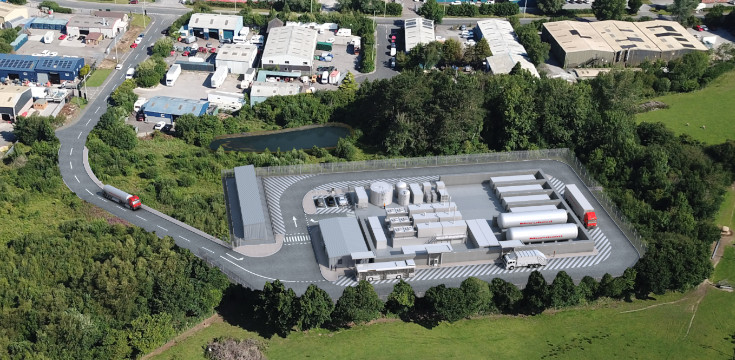
Last week, Bridgend Council’s Planning Committee met to decide the planning application and hazardous substances consent for the Hybont project at Bryncethin and Brynmenyn.
As there’s a lot of interest in this – and it’s going to be one of the most controversial planning applications of the current council term – it’s covered in more detail than usual.
You can move between the different sections by clicking next or by using the drop-down menu.
TL;DR: It was granted permission on both counts; the final decision is up to the Welsh Government – skip to the final section for more.
The entire, almost four hour, meeting is available to watch here.
The first part of the meeting focused on the hazardous substances consent – mainly on how it would be enforced. It was confirmed that BCBC would be responsible for enforcement despite their lack of experience when it comes to hydrogen, though they can turn to HSE for advice.
The Committee agreed to a planning officer’s proposal to add a condition whereby Maurbeni would have to provide BCBC with detailed information on how much hydrogen is being produced at the plant to ensure they are not exceeding limits. This information would be identical to that provided to the UK Government to access grant funding as part of a subsidy agreement.
The amended hazardous substances consent was approved by 11 to 2.
The second half of the meeting focused on the main planning application.
A planning officer told the Committee that transport issues were considered in “great detail”, with BCBC confident the local road network can cope with extra traffic – though that doesn’t mean there aren’t congestion issues at Junction 36 and elsewhere.
They went on to add that many of the objections boil down to Hybont being in the “wrong location”. That wasn’t the case because despite its location it would need to comply with scores of conditions.
This was expanded on further by Cllr. Jonathan Pratt (Con, Newton). He noted that the report described Hybont as being very similar to the Tyseley Energy Park in Birmingham. He sought further clarification as to why.
Councillors were told they were “practically identical” (though there was some wrangling over the legal definition of this), in that Tyseley is a hydrogen production and fueling facility located in an industrial estate close to a residential area. Anecdotally, hydrogen stations in Aberdeen were also located on the edges of industrial estates and residential areas.
Cllr. Simon Griffiths (Lab, Brackla East & Coychurch) started a discussion on the “greenness” of the project – particularly its energy supply.
The Committee were told that while the solar farm would only supply up to 20% of Hybont’s energy requirement, energy from the grid would be generated by wind – making the hydrogen produced by the plant “green” as it would be produced entirely from renewables.
The application was subsequently approved by 10 to 2.