


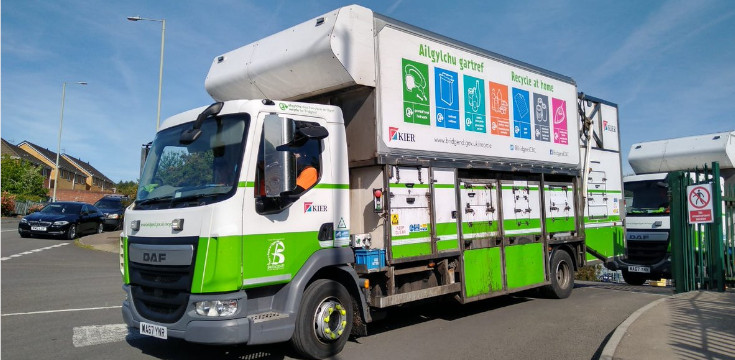
Three options for the longer-term future of Bridgend Council’s waste and recycling service were discussed by a scrutiny committee earlier this week.
It follows the publication of a consultant’s report – which you can read here (pdf) – which examined the options in detail.
Stop-gap contract to start next month


The present seven-year waste & recycling contract with Kier ends on 31st March.
As most of you will be aware, the final weeks of the contract have resembled its shambolic beginnings – regular missed collections, vehicle issues and long queues at tips.
A two-year “stop-gap” contract has been signed with Great Yarmouth-based environmental consultancy Plan B Management Solutions.
They’ll take over on April 1st 2024, with the contract running until March 31st 2026. While Plan B have expertise in consulting on environment, recycling and waste management, they don’t appear to have any direct experience in providing waste and recycling services on the ground.
The two-year contract length was agreed to give Bridgend Council enough time to fully consider their options beyond 2026.
What did the consultant’s report say?
Option One: Bring waste and recycling services in-house.
This is the most expensive option, with an expected cost of £9.37million-per-year and set-up costs of £765,000. It would require a management restructure and a renegotiation of pay, pensions and conditions as recycling staff would be directly employed by the council.
The main advantage is that BCBC would have full control over the service. That brings with it more flexibility as well as the advantage of no longer having to meet strict profit margins.
Option Two: Transfer the service to a council-owned company (LATCo).
This is the cheapest option in terms of running costs at £9.02million a year. However, the set-up costs were the highest at £971,000.
A company wholly owned by BCBC would be set up, with current staff transferring via TUPE. BCBC would take on all of the risks, but the service would be allowed to make a profit and compete as a third-party/commercial waste company.
Option Three: Continue to outsource the service to a private company.
This is what BCBC currently does. The annual costs are almost the same as the LATCo option (£9.03million), but the set-up costs are the lowest (£529,000). It received the best score in the risk assessment too.
Whichever company takes on the contract employs the staff and absorbs a lot of the risks. Also, the contractor makes most of the operational decisions and any changes BCBC would want to see would need to be negotiated beforehand.
The big issue is that fewer private companies are interested in taking on council waste contracts.
The report says that only Northampton-based FCC Environment was firmly interested in a future 7-8 year contract with Bridgend Council; Biffa (put off by the idea of running tips/recycling centres) and Urbaser (being bought by FCC) were on the fence.
Committee: In-house and LATCo options should be explored further
The scrutiny committee weren’t asked to make any decisions, only offer recommendations ahead of a future report to the Cabinet.
The consensus was that the in-house service and LATCo options were both “workable” – even if they come with risks – and should be explored further by the Cabinet. However, there wasn’t enough information for the committee to back a single option at this time.
I’m sure this is only a coincidence, but Plan B Management lists “the creation and mobilisation of….Local Authority Trading Companies (LATCo)” amongst their areas of expertise.


