Image Source: ITV News Wales
Oggy Bloggy Ogwr doesn’t receive any subsidy and isn’t funded by the BBC. If you like what I’m doing here and think this work is important in keeping locals informed of what’s happening in Bridgend, consider a donation. One-off or monthly; as little or as much as you want. Click the links below, or full details are available here.
This month’s full council meeting was dominated by a debate concerning flooding and flood management in Bridgend County.
BCBC took the unusual (but welcome) step of asking the public to suggest questions.
From the outset, several councillors expressed disappointment that major agencies involved in flood management – such as Natural Resources Wales (NRW), utilities companies and Dwr Cymru/Welsh Water – didn’t send any representatives.
I went into it expecting fewer statements and more questions to be answered. Though, in fairness, not every question could’ve been answered properly because the people who could answer them (from NRW etc.) weren’t there.
There were some “technical/practical” points made regarding how BCBC deals with flooding. I’ve decided to focus on those.
Council Leader backs central emergency response centre to support residents
Council Leader, Cllr. John Spanswick (Lab, Brackla West Central), said a regional board was currently undertaking a climate change risk assessment. BCBC cannot deal with major flooding events alone and needs to work with agencies like NRW, utilities and the emergency services.
He agreed with a point raised by Cllr. Tim Thomas (Ind, St. Bride’s Minor & Ynysawdre) that there are natural flood prevention measures – such as ponds and trees – which can slow down water flows.
Cllr. Spanswick also suggested setting up a single emergency resource centre to provide emergency supplies (beds, heating, cooking supplies etc.) at short notice to residents affected by severe weather. No such facility currently exists, and when residents of Bettws faced a lengthy power outage towards the end of last year, councillors had to provide emergency supplies themselves.
Cllr. Alex Williams (Ind, Pencoed & Penprysg) mentioned that a scrutiny committee recommended an emergency reserve/contingency fund be established for extreme weather events; he welcomed a commitment from the Cabinet to consider it for future budgets.
He warned, however, that it was too easy to look to cut “climate change spending” (which includes funding for flood prevention and management) as a short-term popular policy when it would inevitably cost more in the longer run.
Cllr. Steven Easterbrook (Ind, Bridgend Central) raised the issue of flooding along Nant Cefn Glas in the Newcastle area of Bridgend. Some homes remain uninhabitable, while some residents have resorted to leaving sandbags out permanently.
Residents are kept waiting for reports and findings, having been told that they could be waiting up to 2 years for Welsh Government funding to be released for work to start on flood prevention measures. The only funding released to date is to cover the cost of planning for those works.
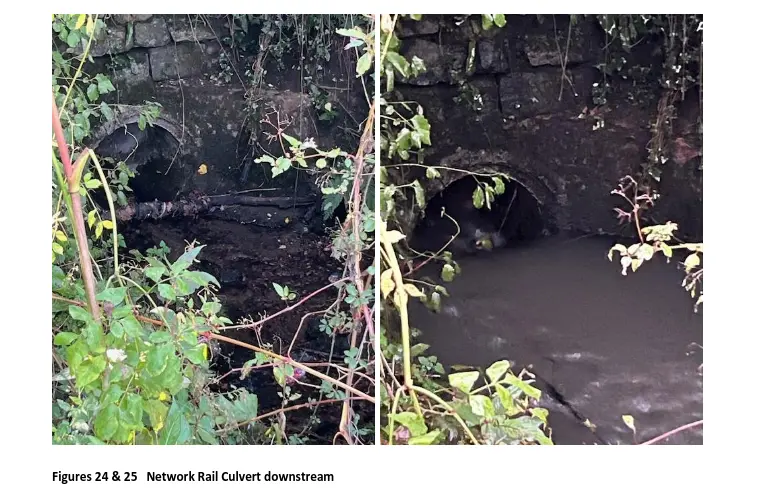
Frequently flooded culverts visited 5,800 times during 2024-25
One issue raised by several councillors on behalf of residents was the maintenance of gullies and culverts.
Cllr. Martin Williams (Ind, Coity Higher) – an engineer with experience working in the water sector – noted we’re in a period of unpredictable rain that overwhelms drainage systems. While residents may not care about “carbon” in the context of climate change, they do care about having their homes ruined.
He believed there was an argument to pivot from “chasing grants” tied to small-scale climate change measures (like tree planting) towards flood engineering.
Joint Cabinet Member for Resources, Cllr. Eugene Caparros (Lab, Brackla East & Coychurch), said recent flood reports underlined that surface water and drainage were in as much critical need of addressing as river-based flooding. A mix of local and major projects have been delivered to date, ranging from larger-scale Porthcawl coastal flood defences to local projects targeting a smaller number of properties.
He supported introducing a “plain English” work schedule so residents can track progress on flood prevention works “street by street”. He would also want to see updated guidance for residents on what to do during a flood, alongside an improved flood alert system.
Cabinet Member for Climate Change & Environment, Cllr. Paul Davies (Lab, Caerau), said water management was now dealt with routinely at new housing developments through attenuation tanks and sustainable drainage.
Currently, there are 26,000 gullies/street drains in the county. These are maintained by 1 gully machine and 2 gully jetting machines. Gullies used to be cleaned every 18 months, but the frequency has been increased to every 12 months.
115 culverts were on what was described as a “critical list” (meaning they’ve faced a significant flood). Some of these are alarmed, and during 2024-25, these were visited 5,800 times.
It was also often the case that during bad weather, culverts are cleared for them to be blocked again a few minutes later.
The range of equipment on hand, as well as the number of times gullies and culverts can be visited and cleared, ultimately comes down to the amount of money available.