Bridgend Council has decided against launching a public consultation on changing the voting system that is currently used to elect the county councillors for Bridgend. The current system is first-past-the-post/multiple non-transferable vote, and the proposed change is to Single Transferable Vote/STV (pdf).
The Local Government & Elections Act 2021 has given Wales’ 22 local authorities the power to choose for themselves whether to switch to STV. The councils have a deadline of three years before each scheduled local election to make their decision.
What is Single Transferable Vote? How is it different to the current system?
At present, in wards that elect one councillor the candidate who receives the most votes wins (first-past-the-post).
In wards that elect more than one councillor, voters have as many votes as there are seats. So if there were three seats, the three candidates who receive the most votes are elected (multiple non-transferable vote).
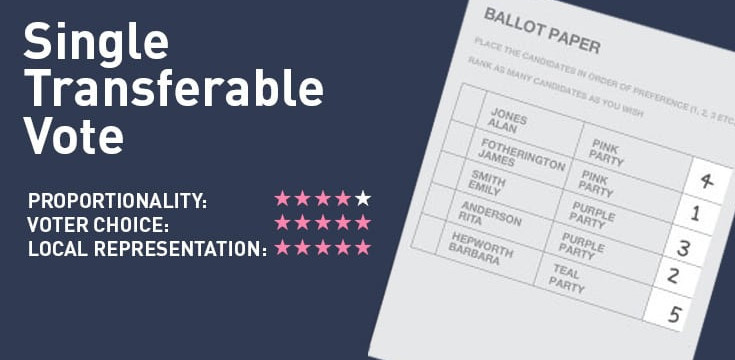
Under STV – which is used for local elections in Scotland, Northern Ireland and Ireland – candidates are ranked by preference.
So instead of putting an X next to a candidate, you put a number (1 for first preference, 2 for second preference etc.) and you can do this for as many or as few candidates as you like.
Any candidate who receives enough first preferences to reach or exceed the quota is elected.
The preferences are then counted and recounted until all of the seats are filled. It looks like this:
Proportional representation has a major advantage, which is that the election result is proportional to the preferences of the voters. This implies that if your preferred candidate is not elected, there’s still a good possibility that someone from your favoured party or group will be elected at some point. This means that no votes go to waste.
It also makes it less likely that one party or group would dominate a council, promoting more cross-party working.
Under the current system, particularly multi-member wards, one party/group can win 100% of the seats with 35-40% of the vote.
What are the key issues?
While the principle of asking voters to count from 1-6 or whatever is simple enough, the process of counting is complex and can take several days.
There are also several caveats the Senedd and Welsh Government agreed to set:
- Local government boundaries would need to be reset again so each ward elects between 3-6 councillors, cutting the number of wards in Bridgend to between 9-17.
- It would only apply to the county council, not town & community councils.
- If BCBC had agreed to switch to STV it would need to be used for the 2027 and 2032 local elections at a minimum.
- Officers estimate that vote counting would cost an extra £25,000-per-day, though this could be sped up through electronic counting machines.
- There’s no budget for the consultation exercise, and every elector in the county would need to be informed in writing.
- Two-thirds of the council (34 councillors) would need to vote in favour of changing the voting system by 15th November 2024.
Unfunded costs of a public consultation the main concern
While there was some support “in principle” for a proportional voting system, most of the opposition came down to the cost of the consultation exercise.
Deputy Council Leader, Cllr. Jane Gebbie (Lab, Pyle, Kenfig Hill & Cefn Cribwr), told members she had been working with electoral reform organisation for several years and supports STV.
However, she couldn’t at this time due to budget pressures and no finances being in place for a public consultation. She believed the Welsh Government should lead any changes.
Cllr. Alex Williams (Ind, Pencoed & Penprysg) thought that another boundary review would lead to too many councillors representing a particular ward, leading to “over-professionalisation” of the role.
Both himself and Cllr. Tim Thomas (Ind, Ynysawdre & St Bride’s Minor) added their warnings over the costs involved. Cllr. Thomas added that a change in the voting system might confuse people. He also believed first-past-the-post provides more direct accountability.
No councillor approved launching a consultation, so it was rejected unanimously without a recorded vote.
The next deadline to hold an STV consultation, after the 2027 local elections, will be November 2029.