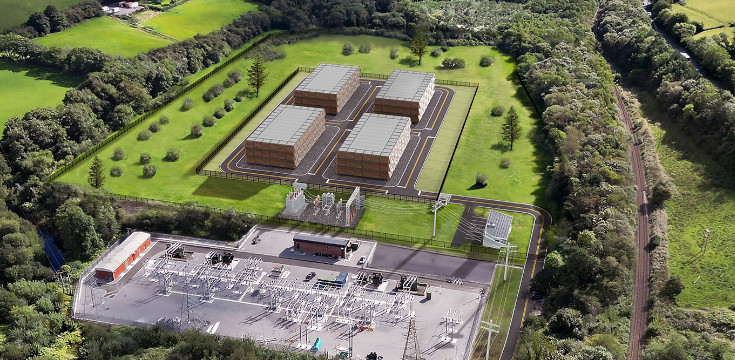
As you may have seen reported earlier this week, a public consultation is set to be launched concerning proposals by American company, Last Energy, for a micro modular reactor (MMR) nuclear power station at the former Llynfi Power Station site to the north of Coytrahen.
The proposed power station would house four micro reactors. Everything would be pre-constructed off-site and then assembled on-site as a kit. Each of the reactor houses would take up around 1000sqm.
Last Energy claims (pdf) that the construction time for the reactor houses is as short as 4 months and everything needed can be transported by road.
The reactor would be housed in an underground pit (called an “island”). It would use uranium dioxide pellets identical to those used in a standard-sized nuclear power station.
The four reactors would generate a combined 80MW. For comparison, the former Aberthaw B coal power station coal power station generated 1,400MW, Hinkley Point C nuclear power station will generate 3,200MW once operational and a single standard-sized wind turbine generates around 3MW.
So this proposal is nowhere near the same scale as a full-sized nuclear power station. Nevertheless, it would generate three or four times more electricity than previously proposed biomass power stations at the site (20-25MW).
There isn’t any further information yet, but the consultation website is up – you can view it here.
I’ll admit to needing to check the date when this was reported – thinking it was yet more AI-generated slop or a dodgy press release regurgitated word-for-word – but it’s real.
The word “nuclear” will naturally get people’s attention.
Before anyone gets too excited (or worried), seemingly every single attempt to build a power station at that site has failed to get off the ground. So I don’t see how this project – which is even more experimental, relatively speaking – would be any different.
Bridgend Council’s involvement in this is likely to be limited too. While they’ll receive the planning application (if/when it comes), either the Welsh Government or the UK Government will make a final decision. This meets the threshold for the Welsh Government to consider it a “development of national significance”, but nuclear energy isn’t devolved.
Undoubtedly, there’ll be questions over whether this is financially viable or provides good value for money. This project reportedly has a £300million price tag and would create 100 jobs – which would be welcome but isn’t anything spectacular and is a lot of investment for very little electricity output.
Last Energy claims they don’t seek public finance, which means securing customers upfront.
The WEPA paper mill is an obvious one. The proposed power station will unlikely generate enough electricity for the new electric arc furnaces at the downsized Port Talbot steelworks. It would be enough to power a large data centre though – such as the one proposed at the former Ford factory.